Category: Tattoo Ideas by Theme
You’ve scrolled past a hundred mountain tattoos and they’re all starting to blur together — the same triangle peaks, the same predictable placement, the same “eh, it’s fine” reaction. Here’s the thing: a mountain tattoo isn’t supposed to be background noise. Done right, it’s one of the most personal, meaning-loaded designs you can put on your skin. And the sixteen ideas below (plus the placement and pain breakdown at the end) are here to make sure yours is one people actually stop scrolling for.
Mountains have carried weight in nearly every culture on earth — sacred, unmovable, worth the climb. So before we get into the 16 designs, let’s cover what you’re really saying when you choose one.
What Do Mountain Tattoos Actually Symbolize?
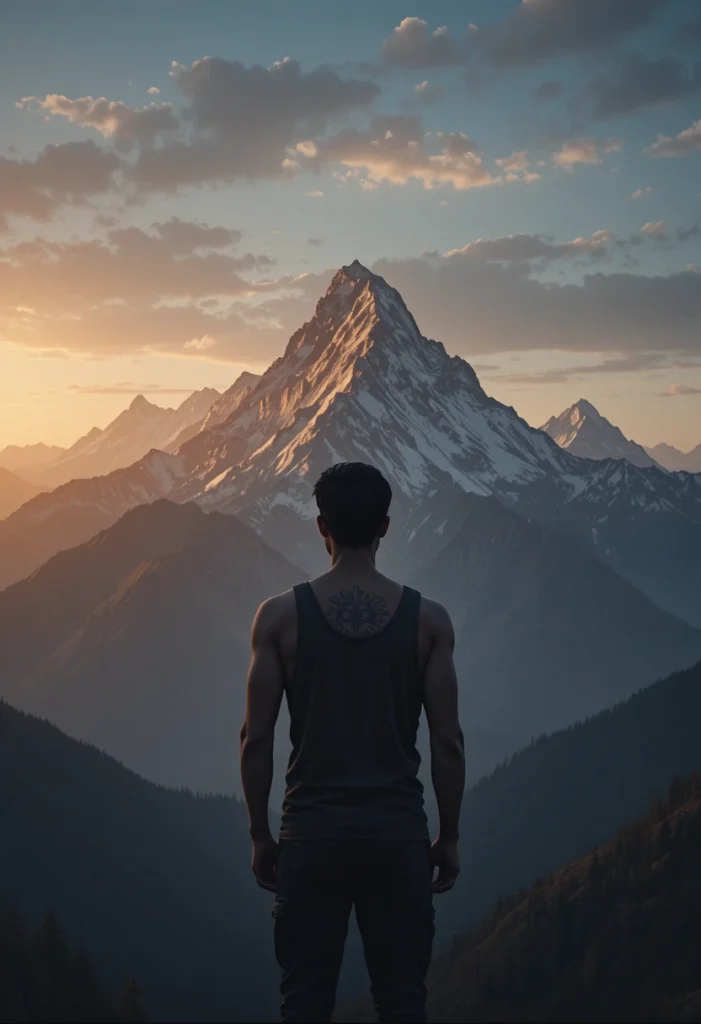
At their core, mountain tattoos represent strength, stability, and the ability to keep climbing even when the path gets steep. They’re a go-to choice for people who’ve been through something — a hard year, a big move, a recovery — and want a permanent reminder that they made it up the other side.
Beyond resilience, mountains commonly symbolize:
- Personal growth — the climb itself as a metaphor for progress
- Freedom and adventure — for hikers, climbers, and van-life dreamers
- Groundedness — mountains don’t move, and neither will you
- Spiritual connection — in Japanese, Buddhist, and Native American traditions, peaks are often seen as sacred, meditative spaces
- Perspective — literally and figuratively rising above the noise
Once you know why you want the tattoo, the design gets a lot easier to pick. So save this for later — the next 16 ideas cover almost every style, size, and vibe you could want.
16 Mountain Tattoo Ideas Worth Saving
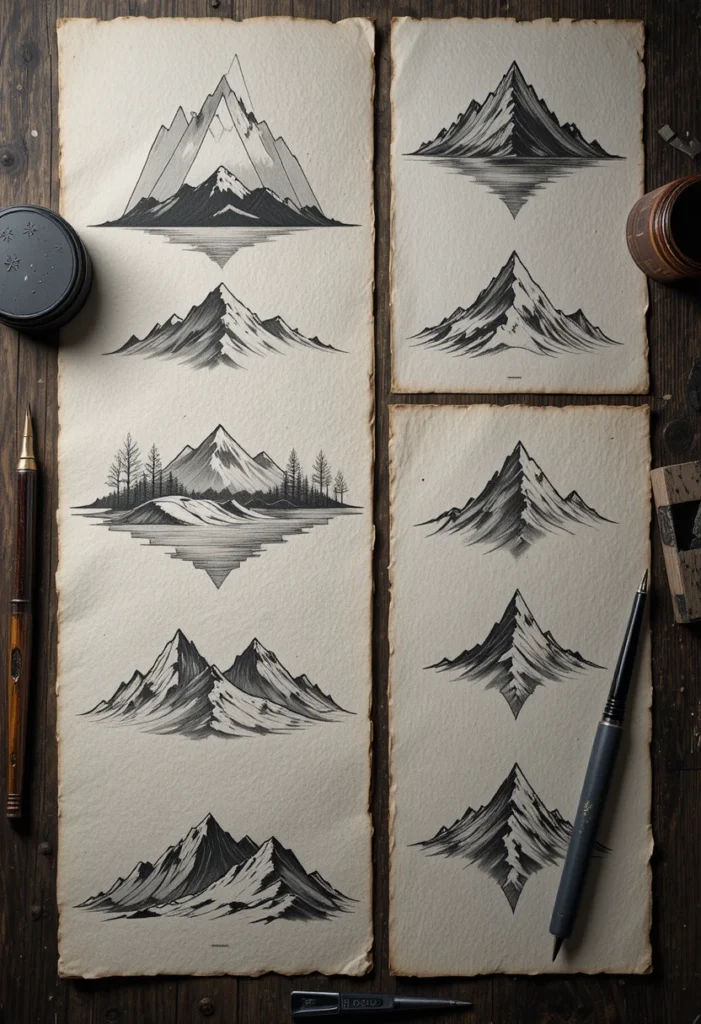
1. Minimalist Single-Line Mountain
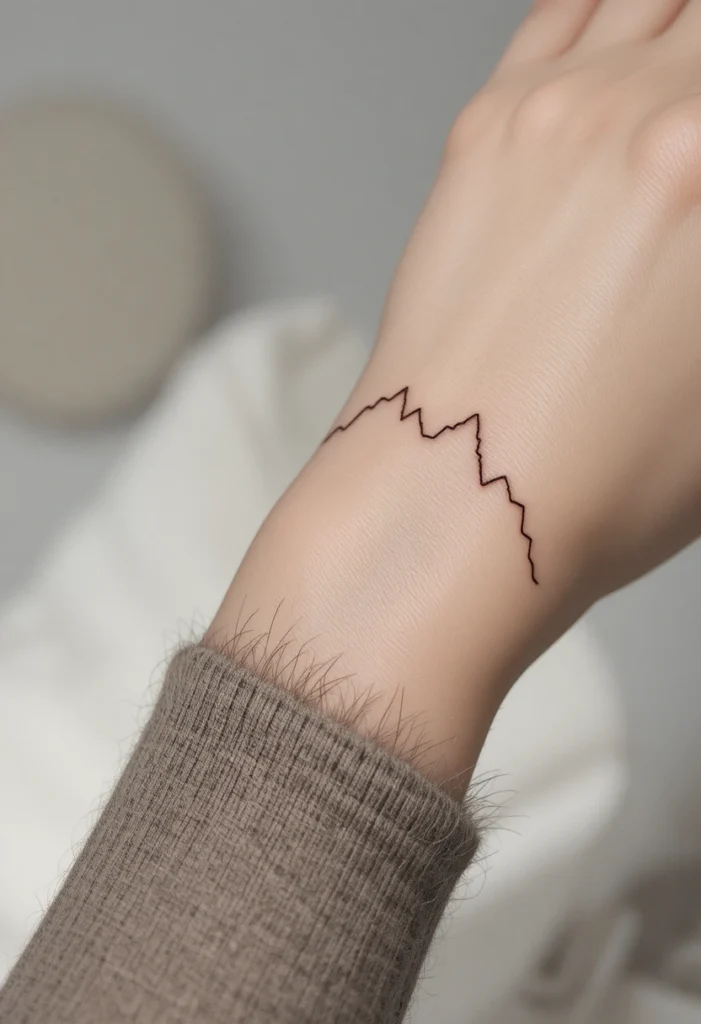
One unbroken line, drawn in a single continuous stroke to form a peak (or three). It’s the most popular entry point into mountain tattoos for a reason — subtle, fast to tattoo, and it ages beautifully because there’s no shading to blur over time.
2. Watercolor Mountain Range
Soft washes of blue, orange, and green bleeding around a mountain silhouette, like the peak is catching a sunrise. This style trades hard outlines for mood, and it’s one of the most pinnable mountain tattoo styles out there — it photographs like a tiny painting.
3. Mountain with a Rising (or Setting) Sun
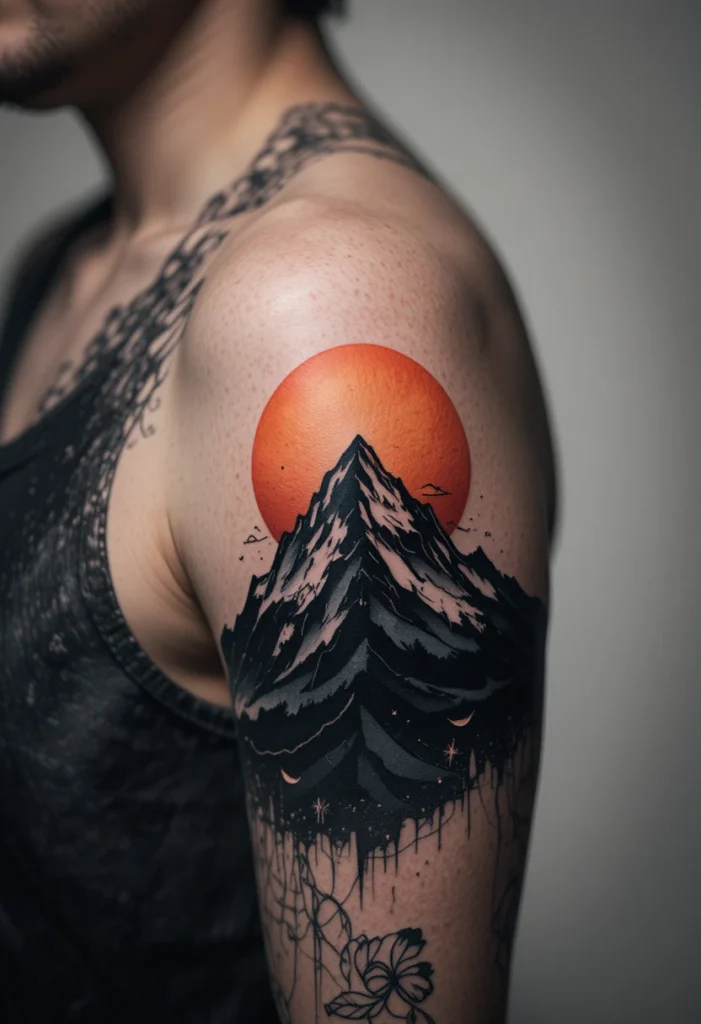
A half-circle sun tucked behind jagged peaks. Simple as it sounds, this combo carries real weight — it’s often read as a symbol of new beginnings or hard-won peace after a difficult chapter.
Read also:13 Teen Tattoo Ideas for 18+ That Are Actually Worth Getting
4. Realistic Snow-Capped Peaks
For anyone who wants their tattoo to look like a photograph. Heavy shading, fine detail, and dramatic light contrast make this a showpiece design — best suited to larger canvases like the forearm, calf, or back.
5. Family Mountain Range
Each peak represents a person. This one’s become a favorite for anyone wanting a family tattoo that doesn’t scream “family tattoo.” A close-set range of three, four, or five peaks — sized or spaced to represent each family member — reads as quiet, grounded, and deeply personal.
6. Geometric Mountain
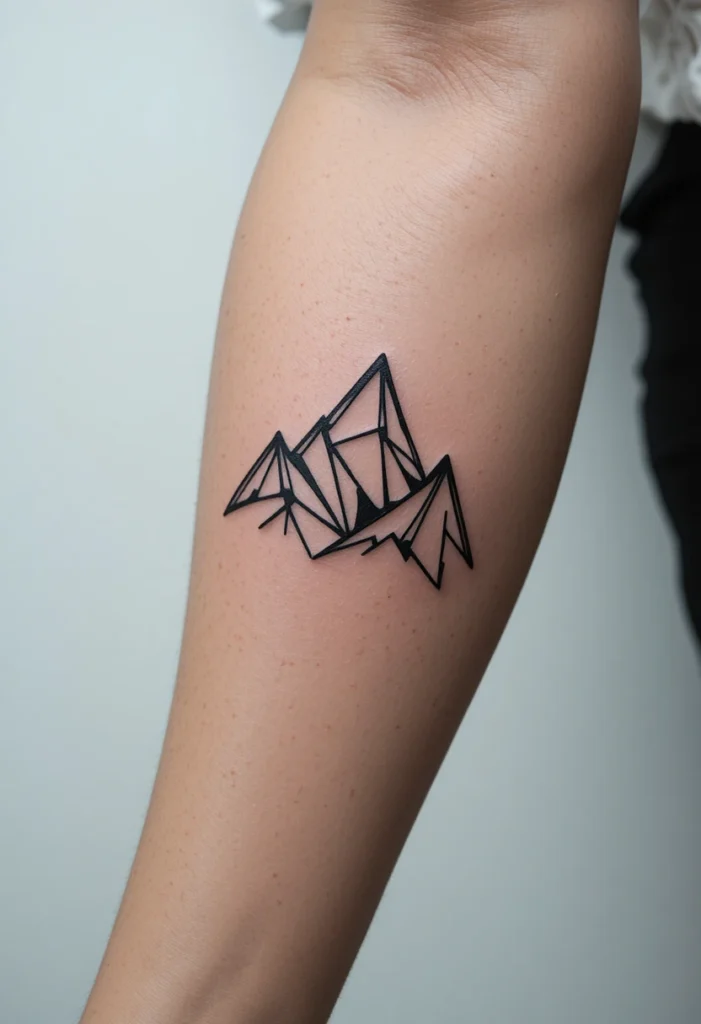
Sharp, faceted lines built from triangles and angles instead of natural curves. It’s the mountain tattoo for people who love structure — clean, modern, and striking even at a small size.
7. Mountain Under a Crescent Moon
A small peak beneath a sliver moon and a scatter of stars — a quiet, nighttime scene that fits neatly on the wrist, nape of the neck, or behind the ear. It’s compact, but it carries a whole atmosphere.
8. Mountain with a Compass or Arrow
Layer a compass rose or a simple arrow into the design and you’ve turned “I love mountains” into “I know where I’m going.” This pairing is especially popular for travel-driven tattoos and milestone pieces (graduations, big moves, solo trips).
9. Japanese-Style Mountain (Fuji-Inspired)
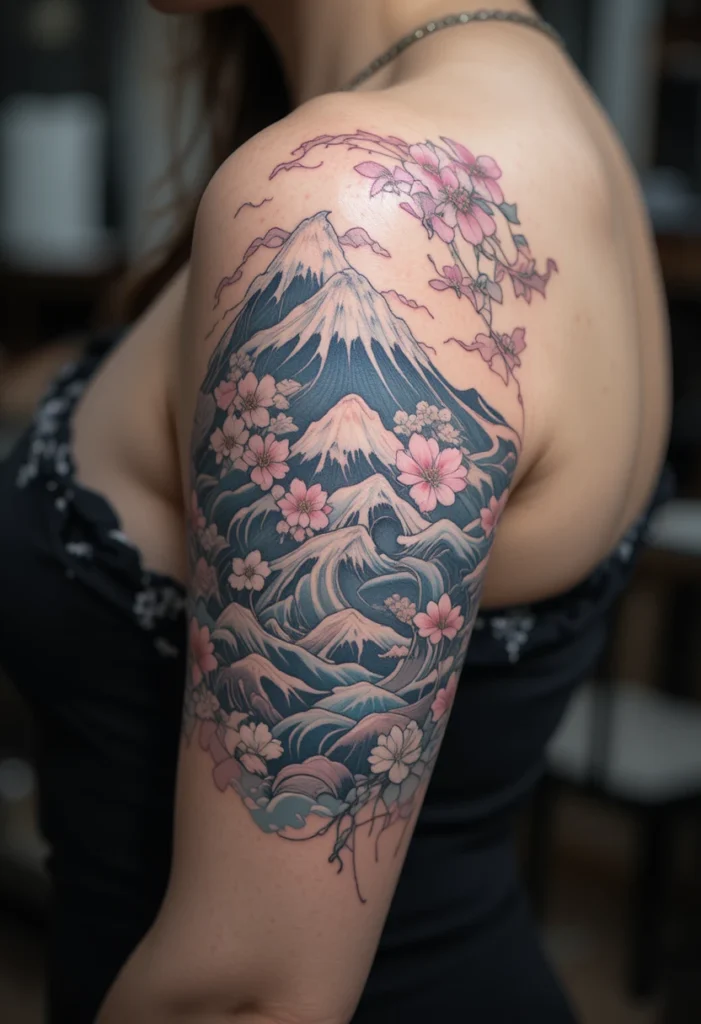
Bold outlines, waves, cherry blossoms, and a snow-dusted peak in the style of traditional Japanese woodblock art. Mount Fuji specifically is tied to luck and prosperity in Japanese culture, making this one of the more symbolically rich options on the list.
10. Mountain with Pine Forest
Layer a tree line into the base of the range and the tattoo shifts from “landscape” to “story.” Pines are often read as symbols of resilience and steady growth — a natural pair for a mountain’s strength symbolism.
11. Mountain Silhouette with Coordinates or a Quote
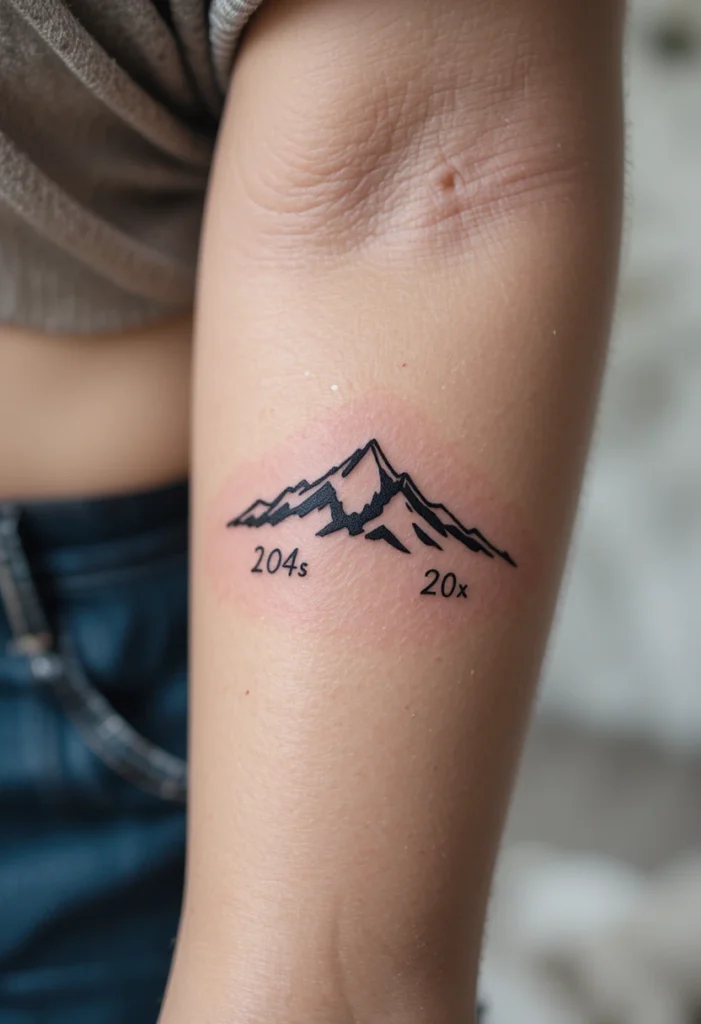
A simple peak outline paired with the latitude and longitude of a summit you’ve climbed, a hometown, or a place you lost someone. Small text tattoos like this hold up well long-term because there’s minimal detail to fade.
12. Mountain and Wave Combo
Peaks on one side, a rolling wave on the other — land meets sea in a single composition. It’s a favorite for people who can’t choose between “mountain person” and “ocean person,” and it reads as a nice metaphor for balance.
13. Blackwork Mountain Range Sleeve
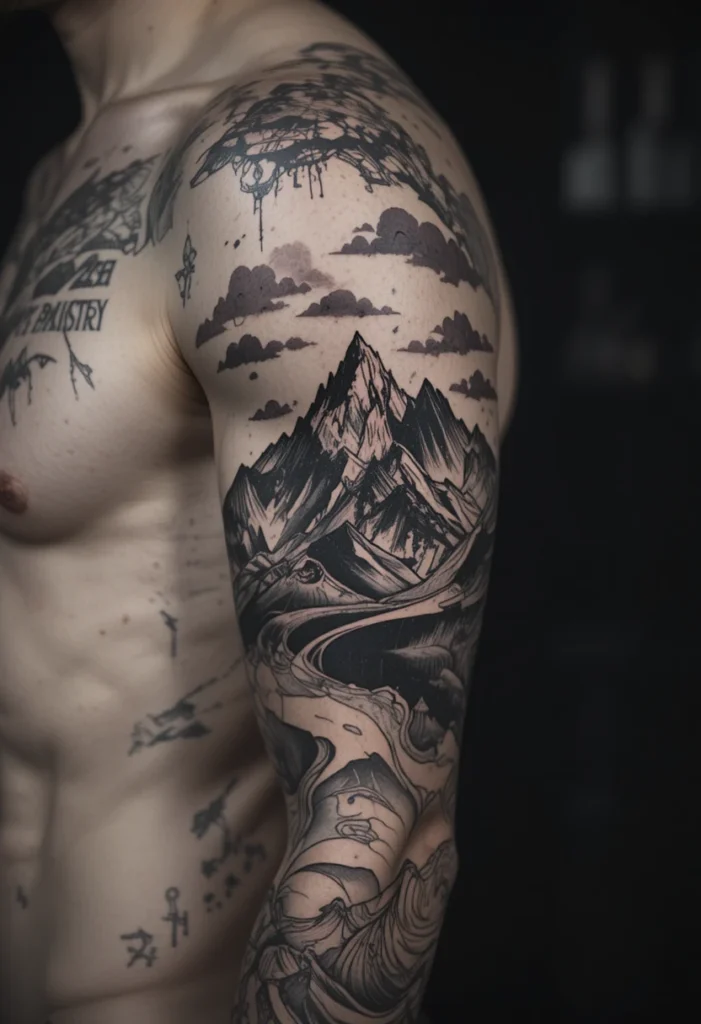
A full sleeve or half-sleeve built from solid black mountain silhouettes layered at different depths, sometimes with negative space cut in for clouds or a moon. This is the boldest, most graphic option on the list — high contrast, high impact.
14. Dotwork Mountain
Instead of solid shading, the entire range is built from thousands of tiny dots, creating texture and depth without hard lines. It’s a slower, more meditative tattooing process, but the payoff is a soft, almost dusty finish you won’t see on every other arm.
15. Mountain Inside a Circle or Triangle
Framing the mountain inside a simple geometric shape gives it a badge-like, almost logo-style finish. It’s a favorite for anyone who wants a mountain tattoo that feels a little more “designed” than “sketched.”
16. Tiny Mountain Outline
Three small triangle peaks, no shading, no color — just a clean outline small enough for a finger, inner wrist, or behind the ear. It’s the easiest, least intimidating way to try a mountain tattoo for the first time, and it’s quick enough to fit into a lunch break.
Best Placements for a Mountain Tattoo
Where you put it changes how it reads — here’s the quick breakdown:
- Forearm — the most popular spot; flat, visible, and wide enough for a full horizontal range
- Wrist or inner arm — best for minimalist or single-peak designs
- Ankle or calf — good for small-to-medium pieces, easy to cover for work
- Ribcage or side — modest and easy to conceal, but a more sensitive, slower-healing area
- Back or shoulder — the go-to for large, detailed, realistic mountain scenes
- Behind the ear or finger — for the tiny outline styles, ideal for a first tattoo
What About Pain and Healing?
Mountain tattoos vary a lot in pain level because the design itself varies so much. A small linework outline on the wrist is a very different experience than a shaded realistic range on the ribs.
General rule of thumb:
- Areas with more muscle or fat (forearm, calf, upper arm) tend to hurt less
- Areas close to bone or with thin skin (ribs, ankle, hands) tend to hurt more
- Larger, more detailed pieces mean longer sessions — and longer sessions mean more cumulative discomfort
Most mountain tattoos heal within 2–3 weeks, though larger shaded pieces on more sensitive areas can take a bit longer.
Before You Book: 3 Quick Tips
- Bring reference, not a rigid demand. Show your artist 2–3 of the styles above and let them adapt it to their hand — you’ll get a better result than asking for an exact copy.
- Size the design to the placement, not the other way around. A detailed realistic range needs real estate; don’t cram it onto a finger.
- Ask about linework longevity. Fine-line and dotwork styles are beautiful but can soften faster over the years than bolder blackwork — worth discussing if you want this tattoo to look sharp a decade from now.
Mountain Tattoo FAQs
Do mountain tattoos have a specific meaning for men vs. women?
Not really — the symbolism (strength, growth, adventure) applies equally. Style preference tends to vary more by personal taste than gender: bold blackwork and realism are popular across the board, as are minimalist linework designs.
What’s the most affordable mountain tattoo style?
Simple linework or a small geometric outline. Less time in the chair, less detail, lower cost — and it’s a great option if this is your first tattoo.
Can I combine a mountain with an existing tattoo?
Yes. Mountains pair naturally with trees, water, celestial elements (moon, stars, sun), animals, and text — a good artist can design around what you already have rather than starting from scratch.
Do mountain tattoos fade faster than other designs?
Fine, thin lines (common in minimalist mountain designs) can soften a bit faster over the years than bold blackwork or heavily shaded realism. Sun exposure and skincare habits matter more than the design itself, though.
Final Thoughts
A mountain tattoo works because it says something true without needing a single word — that you climbed, that you’re steady, that you’re still going. Whether you land on a two-second minimalist outline or a full realistic back piece, the best design is simply the one that matches the story you actually want to tell.
Save this list, screenshot your top three, and bring them to your consultation — that’s really all the prep you need.